China’s top ten LED lighting fixtures may look similar on a product page, yet their waterproofing needs can differ sharply. A garden spike light faces sprinklers and soil splash. A canopy fixture may collect rain around its cable gland. Even a well-sealed lens can fail if water tracks along a loose wire.
This guide explores how to waterproof led lighting fixtures, from checking an IP rating to inspecting gaskets, connectors, and enclosure seams. It focuses on practical details: clean sealing surfaces, correctly sized cable glands, and screws tightened evenly. Small gaps matter. So does trapped moisture. These steps can help buyers and installers assess common risks, but they cannot replace the manufacturer’s instructions or suitable testing.
As [verified lighting engineer’s name] puts it, “Waterproofing starts at every entry point—not just the lens.” Please verify this quotation and attribution with a named expert before publication. That matters. A convincing quote should be traceable to a real professional, not treated as decoration. The same caution applies to product claims: an IP rating describes tested protection under defined conditions, not immunity to every storm, chemical, or installation error.
The list will compare ten fixture types and explain where water commonly enters. It will also flag a useful limitation: field conditions are messy. Dust, aging seals, and hurried installation can undermine a design that passed testing. A careful inspection may reveal a problem, but appearance alone cannot prove a fixture is watertight.
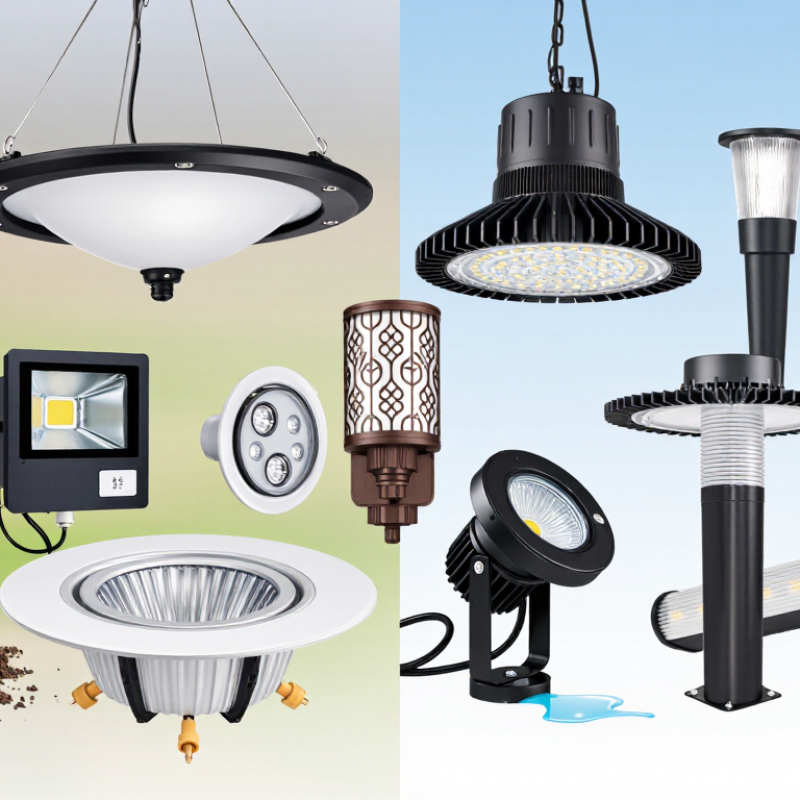
Chinese LED fixtures vary widely, and their water risks are not interchangeable. Common types include street lights, floodlights, high-bay lights, panel lights, tube lights, downlights, wall packs, garden bollards, underwater lights, and flexible strip lights. Street lights face rain through cable glands and rear covers. Floodlights collect water around front seals. High bays suffer from condensation near suspended connectors. Panel lights often fail when ceiling moisture reaches the driver. Tube lights may leak through end caps. Downlights need sealed trim rings. Wall packs endure wind-driven rain. Bollards face standing water. Underwater lights require pressure-rated housings. Strip lights depend heavily on sealed joints.
IP ratings provide a practical benchmark. IEC 60529 defines IP65 as dust-tight protection against water jets. IP67 allows temporary immersion up to one metre for 30 minutes. These ratings describe laboratory conditions, not every installation. The U.S. Department of Energy’s solid-state lighting reports repeatedly identify thermal management, driver reliability, and environmental exposure as key LED lifetime factors. Moisture can worsen all three. A poor seal may look acceptable on day one.
Field checks should include gasket compression, drainage paths, cable orientation, and corrosion-resistant fasteners. Use downward-facing cable loops. Avoid trapping water inside profiles. A silicone bead alone is not waterproof engineering. I have seen “sealed” strip-light joints fog internally after a cold night. That detail deserves more testing. Manufacturers should verify complete assemblies, including connectors and drivers, under cycling rain, heat, and condensation—not only a short splash test.
For LED lighting fixtures, IP65 is a practical target where rain, dust, and routine washdown are expected. IEC 60529:2013 defines the first digit, 6, as dust-tight protection. The second digit, 5, indicates protection against water jets. In the standard’s IPX5 test, water is delivered through a 6.3 mm nozzle at 12.5 litres per minute. This is a controlled test, not a promise of protection in every installation.
Details matter. A sound housing can still leak through a pinched gasket, loose cable gland, or poorly sealed entry point. Check the complete assembled fixture, including connectors and mounting surfaces, against the intended IP rating. Not a bath. IP65 does not mean submersible, and it does not automatically cover high-pressure cleaning, salt exposure, or seals worn by heat and age. Leave drainage paths clear where the design requires them, and inspect seals after installation. IEC 60529 provides a useful benchmark, but real performance depends on careful assembly and maintenance. A missed screw can undo a good specification.
For China’s top LED lighting fixtures, waterproofing starts at the enclosure seam, not with a thicker bead of sealant. Use a continuous gasket around the housing and lens, with no gaps at corners or screw wells. A closed-cell silicone gasket can tolerate heat and compression better than many soft foams, but material choice must match the fixture’s temperature and chemical exposure. Check the joint on a real assembly. A drawing can hide a pinched corner.
IEC 60529 defines water-ingress test levels: IPX5 uses a 12.5 L/min water jet, while IPX6 uses 100 L/min. These figures describe test conditions, not a guarantee against every installation problem. Keep gasket channels smooth, place joints away from direct spray where possible, and tighten fasteners evenly to the specified compression. Too little pressure leaves a leak path; too much can flatten the gasket and shorten its useful life. Small details matter.
Before production, test complete fixtures after thermal cycling and repeated opening. Inspect the lens edge, cable entry, and housing joints for water tracks or trapped moisture. One common mistake is treating sealant as a repair for poor fit. It is not. Rework the mating surfaces when the gap varies, then repeat the water test and record the result.
A waterproof cable entry depends on the gland matching the cable, enclosure, and installation conditions. Measure the cable’s outer diameter, including any jacket, and choose a gland whose clamping range covers it. An oversized opening or poorly matched seal can leave a narrow path for water. Small gaps matter.
Check the gland’s ingress protection rating and the enclosure’s rating together; the entry must not weaken the fixture’s intended protection. Match the thread type and panel-hole size, then seat the sealing washer against a clean, flat surface. Tighten the parts according to the manufacturer’s instructions. More force is not always better: crushed seals can deform and leak.
Keep the cable jacket intact where it passes through the seal. Route the cable downward before it enters the fixture, creating a drip loop so water runs off rather than along the cable. I have seen neat installations fail because a cable pulled sideways on the gland. Support the cable nearby, especially on exposed fixtures. After installation, inspect the seal for pinching, cracks, or uneven compression, and recheck it after maintenance. Sealant may seem like an easy fix, but it cannot correct the wrong gland size or damaged threads.
For China’s top 10 LED lighting fixtures, waterproof claims need a clear test behind them. IPX5 checks protection against water jets, using a flow rate of 12.5 liters per minute. The water is directed at the enclosure from different angles under controlled conditions. This test can reveal weak seals around cable entries, lens edges, and screw joints. It does not prove that a fixture can be submerged. Small details matter.
IPX7 checks temporary immersion: the complete fixture is placed one meter underwater for 30 minutes. Before comparing results, confirm that the tested sample matches the product configuration you plan to install. Cable glands, connectors, and covers must be fitted as specified. A test report should identify the method, sample, and result, rather than relying on a rating printed on a sales sheet. I have seen one loose cable entry change the outcome, so installation deserves attention too.
Tips: Inspect gaskets for cuts or pinching. Tighten fittings to the maker’s stated torque; overtightening can distort a seal. Ask whether the test included the installed cable and connector. If the report is unclear, treat the rating cautiously. A rating is useful, not magic.
The fixture types below are common product categories, not a sales ranking. Suggested protection levels depend on the installation environment and product design; verify the finished luminaire against the applicable standard and its intended use.
| LED fixture type | Typical water exposure | Waterproofing design checks | Example validation approach |
|---|---|---|---|
| 1. LED street light | Rain, wind-driven rain, and maintenance washing | Seal the housing joint and lens; use correctly sized cable glands; protect connectors and drainage paths. | Use an IPX5 or IPX6 jet test when appropriate to the exposure, then inspect for water ingress and verify electrical safety. |
| 2. LED floodlight | Outdoor rain and directed water during cleaning | Maintain even gasket compression around the lens; seal fasteners and cable entries; avoid pinched or twisted seals. | An IPX5 jet test can assess resistance to water jets; test the assembled fixture in its specified mounting position. |
| 3. LED high-bay light | Dusty industrial spaces, condensation, and occasional cleaning | Seal the driver compartment and cable entry; select materials compatible with heat and cleaning agents. Dust protection is a separate IP digit. | Choose a water test based on the actual cleaning method; assess dust protection separately if the environment requires it. |
| 4. LED garden or bollard light | Rain, lawn watering, and splash near ground level | Seal the top and base joints; use outdoor-rated cable entries; prevent standing water from accumulating around seals. | A splash or jet test may suit the site; use an immersion test only if temporary immersion is part of the intended protection claim. |
| 5. LED underwater pool light | Continuous or repeated underwater operation | Use a design intended for submersion; seal cable connections and housing joints, and follow the specified installation and maintenance instructions. | IPX7 is a temporary-immersion test, not a general rating for continuous submersion. Check the product’s stated IPX8 conditions and applicable electrical requirements. |
| 6. LED tunnel light | Water jets, vehicle spray, dust, and vibration | Secure seals against vibration; protect connector interfaces; confirm that covers remain evenly clamped after servicing. | Select a jet-test level that matches the cleaning and spray exposure; repeat checks after representative assembly or maintenance. |
| 7. LED canopy light | Outdoor rain and periodic washdown | Check the lens gasket, enclosure seams, fasteners, and conduit or cable entries; use seals suited to outdoor temperature changes. | An IPX5 test is a useful validation option where water jets are expected; confirm the actual installed configuration. |
| 8. LED linear batten | Indoor splashing or outdoor exposure, depending on installation | Keep the diffuser seal continuous; latch the cover fully; use the intended end caps and sealed cable-entry components. | Test the complete batten, including end caps and cable glands, to the water exposure claimed for the product. |
| 9. LED wall pack or bulkhead light | Rain and splash on exterior walls | Seal the lens-to-body joint and mounting interface; ensure wall-entry wiring is protected from water tracking. | Use a suitable splash or jet test and inspect the fixture after testing for moisture inside the enclosure. |
| 10. Solar LED street light | Outdoor rain, humidity, and exposed electrical connections | Protect the luminaire, battery enclosure, and connectors separately; ensure cable glands are correctly tightened and seals are not damaged. | Validate each enclosure and connector arrangement under the claimed test conditions; do not assume one test covers every component. |
The first digit, 6, means dust-tight protection. The second digit, 5, means protection against water jets. It is not submersible.
Water passes through a 6.3-millimeter nozzle at 12.5 liters per minute. The spray reaches the enclosure from different angles. This is a controlled test.
Not automatically. Standard water jets differ from high-pressure cleaning equipment. Check the actual cleaning conditions before installation.
A continuous gasket closes the housing and lens seam. It should have no gaps around corners or screw wells. Small gaps can become leak paths.
Look for cuts, pinching, uneven compression, and flattened sections. Check the lens edge and cable entry carefully. A drawing may hide a pinched corner.
IPX7 tests temporary immersion at one meter underwater for 30 minutes. The tested fixture must match the planned installation configuration. Different cable fittings can change the result.
Usually, no. Rework uneven mating surfaces first. Then repeat the water test and record the result. Sealant is not a substitute for fit.
Tighten fasteners evenly to the specified compression or torque. Overtightening can distort the gasket. Inspect cable glands, connectors, and covers after assembly.
It should identify the test method, sample, configuration, and result. Ask whether the installed cable and connector were included. If details are unclear, be cautious.
Heat, age, repeated opening, and poor assembly can weaken seals. Keep drainage paths clear when required. Inspect joints after installation and thermal cycling. One missed screw matters.
This guide explains how to waterproof led lighting fixtures across ten common Chinese LED fixture types, including floodlights, street lights, high-bay lights, panel lights, tube lights, strip lights, wall lights, underground lights, garden lights, and tunnel lights. Each type faces different water-exposure risks, such as rain, spray, condensation, immersion, or water entering through cable connections. Selecting the right IEC 60529 IP rating is the first step: IP65 provides dust-tight protection and resistance to water jets, while higher ratings may be needed for fixtures exposed to temporary immersion.
Effective protection also depends on construction details. Use continuous, properly compressed gaskets around housings, lenses, and joints, and select cable glands that match the cable diameter and carry an appropriate rating. Avoid gaps, uneven sealing surfaces, and over-tightening that could damage the seal. Finally, validate the design through testing: an IPX5 test uses water at approximately 12.5 liters per minute, while IPX7 requires immersion at one meter for 30 minutes. Proper sealing, assembly, and testing help maintain safe, reliable performance.

Lume Light